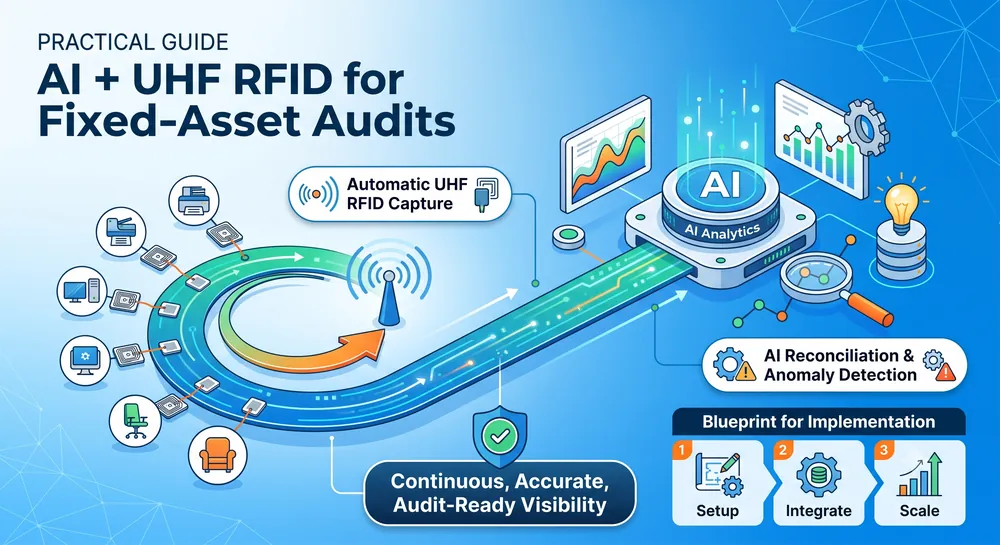
How pairing automatic UHF RFID capture with AI analytics turns the slow, error-prone fixed-asset audit into continuous, accurate, audit-ready visibility.
The fixed-asset audit is one of the most expensive routines an organisation repeats. Teams spend weeks reconciling spreadsheets against the floor, accuracy is rarely better than the last person to update a record, and the result is a snapshot that is out of date the moment it is signed off. Pairing UHF RFID with AI analytics changes the model entirely: RFID captures every tagged asset automatically and in bulk, and AI turns those reads into reconciliation, anomaly detection, and forecasting. The audit stops being a periodic project and becomes a continuous, always-current view. This guide covers why traditional audits fail, what each technology contributes, and a phased blueprint for putting it in place.
Why traditional asset audits fail
Manual audits share three weaknesses: assets are reconciled by hand, records are inaccurate or missing, and the whole exercise is costly and carries compliance risk. But the deeper problem is that the underlying record is wrong almost as soon as it is created — an item moves, the sheet is not updated, and the books and the floor drift apart. That drift shows up differently across sectors:
- Corporate enterprises carry untracked "shadow" purchases that bypass procurement, book values disconnected from real asset condition, and asset-consolidation headaches during mergers — all while manual processes add avoidable risk to financial-controls compliance.
- Banks face regulatory reporting that depends on accurate asset data, high-value equipment (trading floors, ATM networks) with poor visibility, and assets scattered across many branches that auditors increasingly want verified in near real time.
- Data centres deal with thousands of near-identical servers, lifecycles measured in months, critical power and cooling systems needing constant oversight, and capacity decisions made blind without accurate utilisation data.
In every case the cure is the same: make the record capture itself, and add a layer of intelligence on top.
What UHF RFID brings: capture without effort
UHF RFID is the data-capture engine. Unlike a barcode, a UHF tag is read by radio, so readers detect assets without line of sight, in bulk, at a distance:
- No line of sight — tags read through enclosures, racks, and packaging, so stacked or boxed assets still get counted.
- Range of several metres — a single reader can sweep a room or aisle; purpose-built tags such as the IP67 REFLECTA MET-A730 read off metal at up to 8.5 m.
- Hundreds of tags per second — an entire shelf or rack is captured in one pass, turning a day of scanning into minutes.
- Standards-based — on the India/EU 865–868 MHz band, complying with EPC Gen2v2 and ISO/IEC 18000-6C. Convalexa's REFLECTA readers, antennas, and tags are built for exactly this.
What AI adds: turning reads into decisions
RFID makes the data current; AI makes it useful. Layered over the read stream, AI:
- Reconciles automatically — matching physical tags to financial records and surfacing only the genuine discrepancies, so auditors stop chasing false mismatches.
- Detects anomalies — flagging unexpected movement, missing assets, or access that breaks the normal pattern.
- Predicts failures — using usage, environment, and maintenance history to flag equipment likely to fail weeks ahead, so maintenance is scheduled on condition, not on the calendar.
- Reads your documents — natural-language processing pulls insight out of maintenance logs and unstructured records that no one has time to review manually.
The synergy in practice
Together the two deliver capabilities neither has alone: a live dashboard of every asset across locations, geofencing alerts when something moves unexpectedly, a complete acquisition-to-disposal chain of custody, and reconciliation that runs in the background instead of consuming an audit team for weeks.
Illustrative example — your figures will vary. Picture an organisation running quarterly audits with ten auditors spending a full week each. Move that to RFID-assisted continuous counting and the same coverage might take a small team a day or two. The point is not a specific percentage — it is the structural shift from a periodic, labour-heavy project to ongoing monitoring, where human attention is spent on the handful of real exceptions rather than on counting. Model it with your own asset count, audit frequency, and labour cost before committing.
An illustrative ROI frame
The value comes from four places, and it is worth quantifying each for your own situation rather than trusting a headline number:
- Labour saved — fewer auditor-hours per cycle, and fewer cycles as monitoring becomes continuous.
- Accuracy gained — fewer discrepancies, write-offs, and duplicate purchases.
- Compliance assured — lower risk of regulatory findings and, often, better insurance terms from demonstrable asset visibility.
- Strategic value — better utilisation and lifecycle decisions from accurate data.
As a rough planning frame, organisations typically weigh a one-time hardware and integration cost plus ongoing software and support against those four savings streams, and look for payback inside the first 12–18 months. Treat any specific figure you read — including in this article — as a worked example, not a promise; the honest number is the one you calculate from your own inputs. Our RFID ROI calculator is a starting point for that.
Implementation blueprint
A phased rollout consistently beats a big-bang one. The shape below generalises across corporate, banking, and data-centre environments; the priorities differ but the phases do not.
Phase 1 — foundation (months 1–3).
Standardise how assets are classified, tag the high-value items first, map the workflows in your existing fixed-asset and ERP systems, and use historical audit data to train the initial anomaly-detection models. The goal of this phase is a clean, tagged, integrated base — not full automation.
Phase 2 — intelligence (months 4–6).
Switch on the analytics: predictive lifecycle forecasting, automated reconciliation of physical condition against book value, risk scoring to prioritise where auditors look, and exception-based processing so people only handle genuine mismatches.
Phase 3 — scale and optimise (months 7–12).
Replace periodic reviews with continuous monitoring, extend coverage across sites, connect procurement, maintenance, and disposal workflows, and track results so the process keeps improving. By this point the audit is a by-product of normal operations rather than an event.
Hardware, at a glance.
You will mix tag types to the environment — standard passive tags for general assets, metal-mount tags for equipment and racks, ruggedised tags for harsh conditions, and tamper-evident tags for high-security items — with fixed portal and area readers for automatic monitoring and handheld readers for spot audits. Exact specification and cost depend on asset count, density, and environment, which is precisely what a pilot is for.
Beyond the audit: advanced use cases
Once the foundation is in place, the same data supports more than compliance:
- Predictive asset intelligence — condition-based maintenance, replacement budgeting, and proactive warranty claims.
- Lifecycle automation — detecting assets ready for retirement, tracking secure data sanitisation, and documenting compliant e-waste disposal.
- Utilisation optimisation — seeing real usage across departments and reallocating under-used assets instead of buying more.
- Cyber-physical security — tamper detection and unauthorised-access alerts where RFID tags integrate with sensors.
How to start
Inventory your high-value assets and quantify what the current audit actually costs you. Define the metrics you want to move — audit time, accuracy, compliance findings. Then run a scoped pilot in one location for a few months, integrate it with your existing systems, train the team, and measure against your baseline before scaling. The first article in this series, on RFID asset tracking for manufacturing, goes deeper on tag selection and pilot design; the RFID mould-mapping piece shows the same principles applied to a demanding real-world process.
Frequently asked questions
UHF RFID handles capture — readers detect tagged assets automatically, in bulk, without line of sight. AI handles interpretation — reconciling reads against financial records, flagging discrepancies and unusual movement, and predicting failures. RFID makes the data current; AI makes it useful.
Because a reader captures hundreds of tags at once without line of sight, a count that took days of manual scanning can be done in hours or minutes. The exact gain depends on asset density and layout; the real shift is from periodic reconciliation to continuous visibility.
Yes, with the right design. UHF RFID reads through racks and enclosures and identifies many assets at once, but dense metal environments need careful tag selection and antenna placement. A pilot validates read reliability before a full rollout.
The India and EU UHF band is 865–868 MHz. REFLECTA hardware is tuned to this band and complies with EPC Gen2v2 and ISO/IEC 18000-6C, keeping deployments standards-based and interoperable across Indian and European sites.
With a scoped pilot on high-value assets in one location, measured against a clear before-and-after metric. Prove the value and surface integration and placement issues on a small footprint, then scale in phases.
Make your assets audit-ready, continuously
Convalexa designs Make-in-India UHF RFID hardware and the VIGI software to run it, and works with you to design the pilot first. See REFLECTA hardware or explore VIGI Track.
Related
An earlier two-part version of this article was first published by the author on Medium. This is the canonical, consolidated edition. The example figures throughout are illustrative planning scenarios, not client results.